
SANUM-KEHLBECK GmbH & Co. KG
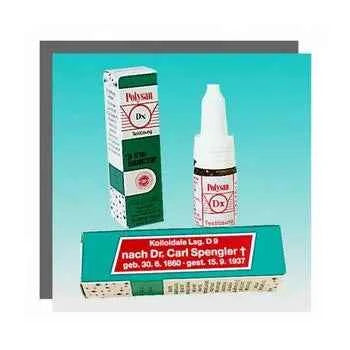
POLYSAN Type DX colloidal solution D 9 Sanum
POLYSAN Type DX colloidal solution D 9 Sanum
Couldn't load pickup availability
POLYSAN Type DX colloidal solution D 9 Sanum
Polysan Dx
Please read this information leaflet carefully, as it contains important information about what you should consider when using this medical device. If you have any questions, please consult your doctor, naturopath, or pharmacist.
The company Polysan was founded in 1945 and was responsible for the production and distribution of Spengler antibodies/antigens in Austria and Italy. The original solutions and the name Polysan were later acquired by Sanum-Kehlbeck GmbH & Co. KG. The products are based on the prescriptions and original formulas of Dr. Carl Spengler and are potentized to D9 according to the German Homeopathic Pharmacopoeia (HAB). They are used for the agglutination test according to Dr. Schwarz and are distributed in Germany as a diagnostic agent.
The Polysan Agglutination Test according to Dr. Schwarz:
The Spengler colloids contain antibodies from the blood of immunized animals that have been vaccinated with specific pathogens or their toxins, as well as detoxified bacterial antigens or toxoids obtained from broth cultures. If antibodies are present in a person's blood as a result of a previous illness, they react with the respective Spengler colloid (see below), which acts as an antigen. The antigen-antibody reaction causes agglutination, i.e., clumping of the immune complexes, which becomes visible macroscopically/microscopically. The degree of agglutination is also a measure of the antibody titer concentration.
Test procedure:
You will need the commercially available polysans (A, E, G, K, M, Om, R, T, D, Dx) and clean microscope slides. Place one drop of each of the desired polysan types on the slides. Using a corner of another slide, scrape off a small drop of blood from the patient's fingertip and mix it with the test preparation. Scrape off another drop of blood with a fresh slide corner. Mix with the second drop of colloid, etc. The results can be read quickly, unless a 5-minute interval is used as a rule to ensure consistent conditions. Even the macroscopic view provides rough indications of the test result, which can be further refined by microscopic examination.
The agglutination result is described according to its severity as follows:
+++ = Very coarse and strong agglutination, indicating a high antibody titer.
++ = Coarse to medium agglutination, indicating a correspondingly moderate antibody titer.
+ = Fine agglutination, indicating a low antibody titer.
- = Negative if no agglutination is observed.
Diagnostic possibilities with Spengler colloids A - E - G - K - M - Om - R - T - D - Dx:
A = Age-related ailments, metabolic disorders, arteriosclerosis, high blood pressure, heart conditions, nervous disorders, periodontitis, prostate disease.
E = Hereditary toxins, especially of a syphilitic nature.
G = Influenza, tonsillitis, suppurations, all inflammations, blood poisoning, febrile illnesses, colds.
K = Circulatory disorders, venous congestion, allergic conditions (asthma, hay fever), varicose veins, precancerous lesions.
M = Malaria, late effects.
Om = Tumors, benign and malignant, precancerous lesions.
R = Rheumatism, gout, neuralgia, uric acid excretion, rheumatism of a tuberculotoxic basis.
T = Tuberculosis, latent and masked manifestations such as asthma, eczema, rheumatism, migraine, scrofula.
D = Focal infections (alternating with Dx).
Dx = Latent focal infections (alternating with D).
This patient information leaflet was last revised in July 2025.
Source: Information from the package insert.
Status: 02/2026
POLYSAN Type DX colloidal solution D 9 Sanum
Share